

Steam applications offer significant benefits across a wide range of tasks in numerous industries. Economical, efficient, and harmless, steam serves as a powerful medium for thermal energy transfer.
Its inherent versatility makes it a critical component in any setting requiring heat distribution. However, processes involving steam demand the utmost caution.
1. Elevated temperatures and pressures render safety a paramount concern that cannot be overlooked, while the presence of condensate droplets can lead to excessive wear and tear on equipment.
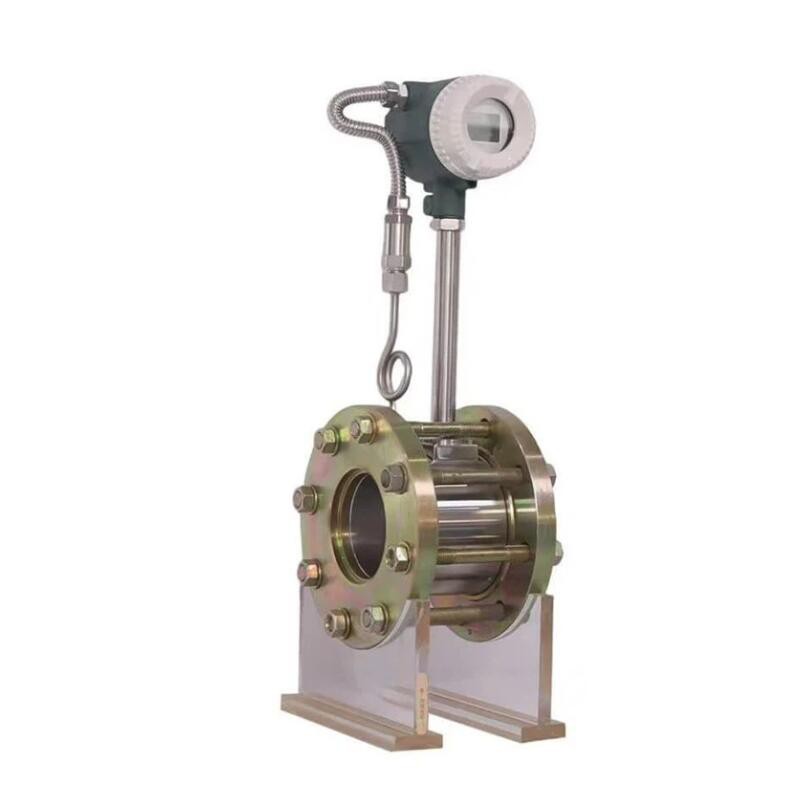
Vortex steam meters are particularly well-suited for measuring the flow rates of both superheated and saturated steam. Their innovative in-situ design enhances both operational safety and efficiency.
By integrating advanced vortex-shedding technology with pressure and temperature sensors, they provide an ideal solution for measuring steam mass flow.
2. The scope of steam applications is vast; essentially, almost every industry benefits from the use of steam in some form.
Steam drives turbines to generate electricity, cleans and sterilizes equipment, and heats reactors in chemical manufacturing processes. These are just a few examples of the countless ways steam meets industrial demands on a daily basis.
Steam is produced by heating liquid water until it vaporizes. This gaseous medium excels at distributing heat uniformly-particularly when compared to other methods of heat transfer.
3. It is recyclable and easy to transport and control. As steam boils and expands, it pressurizes the system.
Steam applications are broadly categorized into two types: saturated steam and superheated steam. Saturated steam is obtained by heating water to its boiling point without applying any further heat.
It serves as an excellent heat source; its high heat transfer coefficient makes it an ideal choice for heating, drying, and sterilization processes.
Superheated steam is produced by heating saturated steam beyond its boiling point until all residual moisture has evaporated. It is widely utilized in fields such as power generation, steam turbines, and drying operations.
Generating steam consumes substantial amounts of energy; consequently, industrial facilities are constantly seeking methods to reduce their energy consumption.
4. Measurement instrumentation can help boost production efficiency by tracking mass flow, thereby enabling operators to optimize their steam usage.
Given that steam involves high temperatures and pressures, traditional flow measurement technologies often encounter difficulties when attempting to measure it. Furthermore, installing these conventional flow meters can be a complex undertaking, as they typically require extensive lengths of straight piping.
The Versatility of Vortex Technology
The vortex steam meter operates by utilizing the von Kármán effect to measure volumetric flow. The sensor detects the vortex oscillations generated as steam is forced to flow around a bluff body within the flow stream.
This information is transmitted to a transmitter, where it is converted into a flow rate value. Additional pressure and temperature sensors can utilize this data to calculate compensated mass flow.
Designed for in-line installation, these meters require no impulse lines. They contain no moving parts, and their fully welded meter bodies eliminate potential leak points-a critical safety feature for steam applications.
The transmitter, mounted externally to the pipeline, can be removed and serviced without interrupting your production processes.