

The vortex steam meter is an application-specific, industrial-grade instrument designed to measure a critical parameter in fluid process control operations: flow rate.
The operating principle of the vortex steam meter is based on the von Kármán effect, which generally states that as a fluid flows past a solid object, it generates alternating vortices.
By detecting the presence of these vortices and determining the frequency at which they occur, the fluid's velocity can be indicated. This velocity value can then be combined with information regarding temperature, pressure, or density to calculate the mass flow rate.
Possessing high reliability and featuring no moving parts, it serves as an effective tool for measuring the flow rates of liquids, gases, and steam.
Different fluids present unique challenges in flow metering applications; among these, steam is considered one of the most difficult fluids to measure due to its inherent pressure and temperature characteristics, as well as the potential for liquid-gas mixtures to coexist within the same pipeline.
Various types of steam-including wet steam, saturated steam, and superheated steam-are widely utilized in process plants and commercial facilities, typically in applications related to power generation or heat transfer.
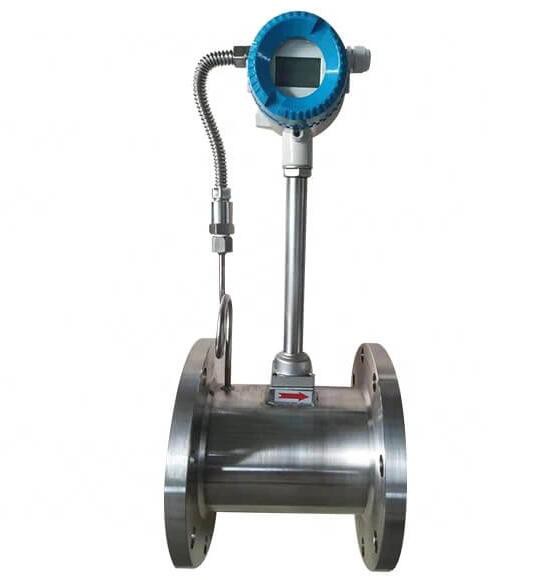
Currently, certain flow measurement technologies are unsuitable for steam flow measurement; consequently, the vortex steam meter occupies a pivotal position within the field of steam flow measurement.
The turndown ratio (defined as the ratio of the maximum flow rate to the minimum flow rate) is a critical consideration for any measuring instrument, as it indicates the instrument's capacity to perform measurements across a specific range.
Vortex steam meters typically feature a wide turndown ratio-a distinct advantage inherent to this technology and this specific type of flowmeter.
In addition to the aforementioned wide turndown ratio and its specialized suitability for steam flow, the advantages of this technology include a measurement accuracy of 1%, linear output, and the absence of moving parts.
To ensure valid measurement results, the pipeline containing the fluid being measured must be kept full.
This technology may encounter obstacles when used to measure slurries or highly viscous liquids.
Since these fluids may fail to generate a sufficiently pronounced von Kármán effect-thereby making accurate measurement difficult-the vortex steam meter is generally not suitable for such applications.
Pulsating flow can also adversely affect measurement results, as pressure differentials between two or more compressors or pumps within a system can cause the fluid flow to become irregular.
When applied correctly, the vortex steam meter serves as a reliable and low-maintenance tool for measuring fluid flow rates.
Vortex flow velocity measurement is often combined with temperature and pressure measurements to form an instrument known as a multivariable flowmeter, which is used to generate a complete dataset for calculating mass flow.
No matter what challenges you encounter in flow measurement, you can consult with flow instrumentation experts.