

The fault inspection process of electromagnetic flowmeter is divided into three steps:
1. Inquire about the past working conditions of the flowmeter and check the recorded curve.
2. Preliminary on-site inspection of the instrument itself for failure and installation location.
3. Check the operation of the pipe network system and the surrounding environment.

Commonly used checks are as follows:
1. Inspection method for electromagnetic flowmeter failure
Resistance method: On-off of fuse, on-off of transmission signal cable and excitation cable, on-off of excitation coil, measurement of electrode symmetry, insulation resistance of electrode to ground, insulation resistance of excitation coil to ground.
Current method: measure the excitation current and measure the output current.
Voltage method: determine whether the power supply of the electromagnetic flowmeter is correct.
Determine the symmetry of the two electrodes. When working, whether the difference between the DC voltages of the two electrodes to the ground is within 10 mV.
It can also be used as a basis for judging whether the SMART board is good or bad.
Waveform method: measure the waveform of key points on the basis of familiar lines, and identify the fault inside the converter circuit board.
Alternative method: Use the interchangeability between the converter and the sensor and between the circuit board components in the converter to determine the location of the fault by the alternative method.
Signal tracking method: use the PLC program to monitor the signal of the flowmeter.
2. Check the electromagnetic flowmeter converter
First of all, check whether the power supply voltage for the converter is consistent with the nominal voltage of the converter, and confirm that the power supply has been turned on, check whether the fuse is in good condition, and confirm whether the circuit board of the converter has signs of burnout, and pay attention to troubleshooting and correction. If the converter fails, since most of the current converters are interchangeable (the standard signal source is uniformly calibrated when leaving the factory), it is convenient to test and replace the converter components and even the entire converter; then check the instrument settings. Whether the parameters have been changed, or consistent with the display instrument (host computer). There are cases that the instrument cannot measure correctly due to improper parameter setting of the instrument or after the user has accidentally changed the factory parameters.

3. Check the electromagnetic flowmeter sensor
The second step to the scene is to check whether the sensor itself is faulty, and then analyze other relevant situations to determine whether the sensor is faulty. Three points:
A. When the pipe is empty, the insulation resistance of the electrode and lead of the sensor to the sensor casing should be infinite. When the pipe is wet, the insulation resistance of the electrode to the casing may also be tens of megohms;
B. The insulation resistance value of the excitation coil of the sensor to the ground should be infinite, and the coil resistance should be about 16 Ω;
C. When the tube is full, the resistance of the electrodes and leads to the sensor housing should be in the order of tens of kiloohms to several hundreds of kiloohms. If the resistance is too large, it means scaling or disconnection. If the resistance is too small, the measuring tube deposits a conductive layer. Whether scaling or deposition of a conductive layer will affect the stability of the measured value display, it must be dealt with accordingly. If necessary, the quality of the sensor lining should be judged accordingly, and whether there are deposits upstream of the sensor that affect the flow rate distribution.
4. Check the electromagnetic flowmeter wiring system
Check whether the type of wire used by the user is consistent with the type required by the manual, and whether the equipotential grounding of the electromagnetic flowmeter is firm. Some users use too much force when wiring, causing the root of the terminal to be broken and the contact to be intermittent. Some users do not understand the concept of grounding, the shielded wire is not grounded, or multi-point grounding is used, resulting in unstable measurement value display.
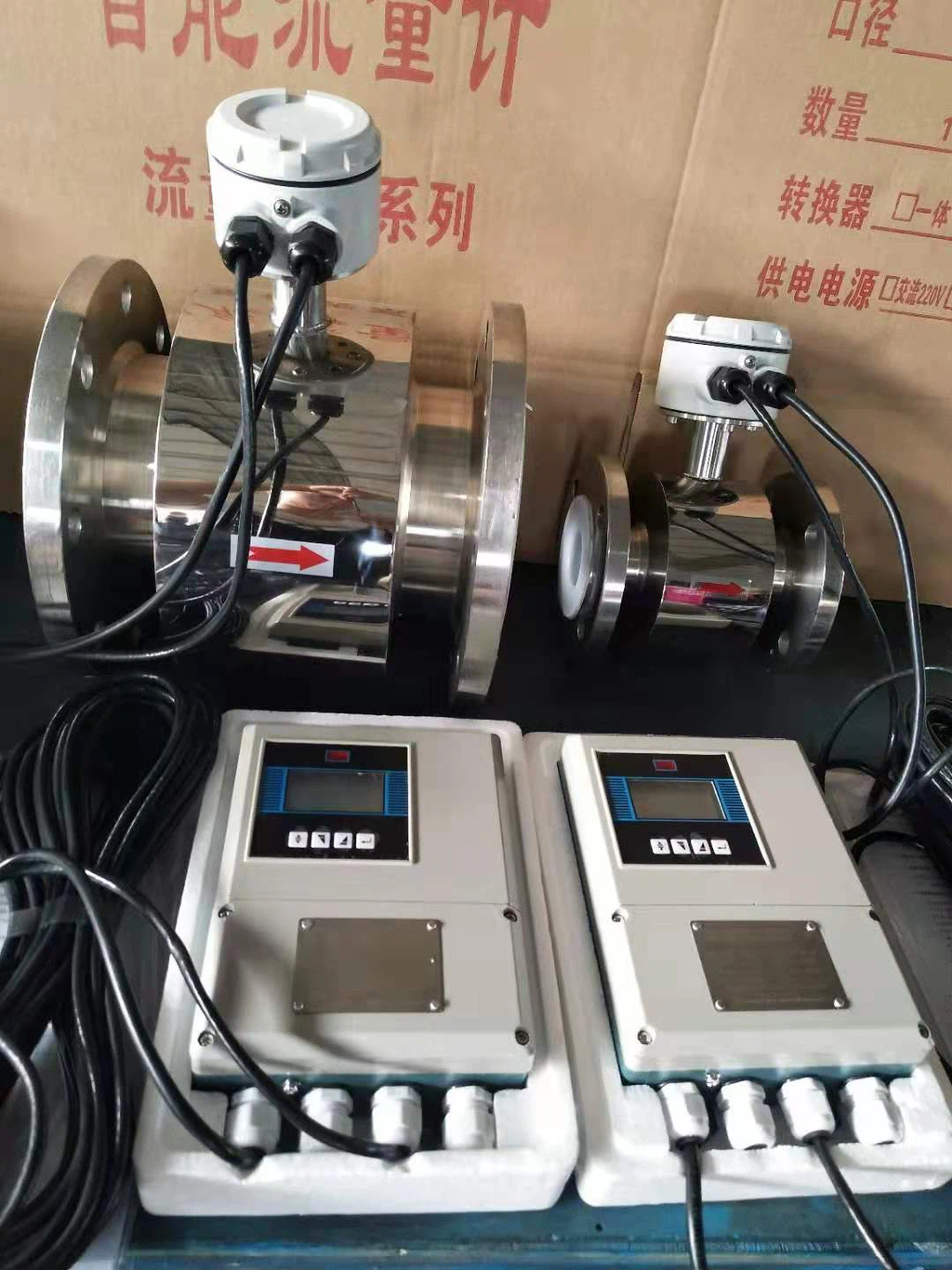
5. Check the installation of electromagnetic flowmeter
Electromagnetic flowmeters have been used in domestic process control for a long time, but unreasonable installations are often seen on site, such as installation at high places in pipelines that cannot run full pipes, insufficient straight pipe sections, too close to the pump, etc. . These are all important factors that cause the instrument to not measure accurately. But some users or designers don't know enough about it. In cases where the measured values show instability, the influence of stray current disturbances must also be considered.
6. Check the inflow and outflow of the flow meter manifold
Users often report inaccurate measurements. In addition to the above checks, it is also necessary to consider whether the inflow and outflow of the manifold are included in the balance calculation of the measured values. This point is often taken for granted by users, and as a high-level technical service engineer, you must have an overall view.