

Electromagnetic flow meters are designed for conductive liquids and offer high accuracy.
Ultrasonic flow meters are suitable for non-conductive fluids and offer non-invasive installation, but may be less accurate in some situations.
Choose based on fluid conductivity, pipe limitations, accuracy requirements, and ease of installation.
Compare the two main flow measurement technologies
You'll find that each flow meter performs best in its specific application.
Below, you'll learn how these flow meters work, their applications, and how to choose the right one for your industrial application.
How do they work?
Electromagnetic Flow Meters: Electromagnetic flow meters utilize the principle of electromagnetic induction. Conductive fluid flows in a magnetic field inside the flow meter, generating an induced voltage, which the flow meter detects through electrodes. The voltage value is proportional to the fluid velocity.
Learn more: What is an Electromagnetic Flow Meter? Principles, Advantages, and Applications
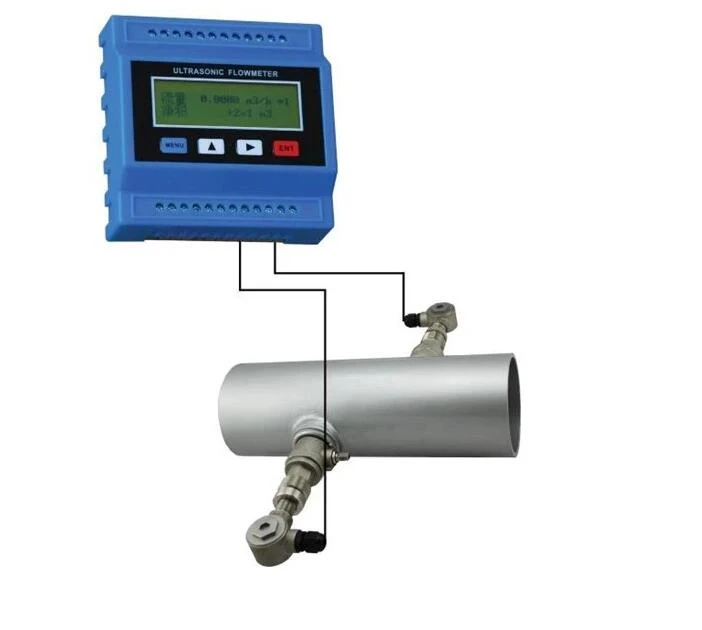
Ultrasonic Flow Meters: Ultrasonic flow meters use sound waves for measurement. They send pulses upstream and downstream of the fluid (time-of-flight method) or utilize the reflection of particles in the fluid (Doppler method). Fluid velocity can be determined by measuring changes in time or frequency.
What types of media and conditions are they suitable for?
Electromagnetic Flow Meters: Electromagnetic flow meters are ideal for measuring conductive liquids (e.g., ionic water, slurries). However, they are not suitable for non-conductive media such as oil or hydrocarbons.
Ultrasonic Flow Meters: Ultrasonic flow meters can be used to measure non-conductive liquids and, in some cases, gases (depending on the flow meter type). They also offer non-invasive installation options (clamp-on) suitable for large pipes.
Key Advantages and Limitations of Electromagnetic and Ultrasonic Flow Meters
Electromagnetic Flow Meters – Advantages: No moving parts, resulting in lower maintenance costs. Good accuracy for conductive liquids. Minimal pressure loss.
Electromagnetic Flow Meters – Limitations: Only suitable for conductive media. Installation may require special linings or pipe conditions.
Ultrasonic Flow Meters – Advantages:
In some cases, installation can be performed without cutting the pipe (clamp-on).
Suitable for large-diameter pipes and non-invasive installations.
Ultrasonic Flow Meters – Limitations:
Accuracy may decrease in the presence of bubbles, solids, or turbulence.
In some applications, its accuracy is slightly lower than the best electromagnetic instruments.
How to choose the right instrument for your industrial needs?
First, evaluate the fluid and piping:
Conductivity: If the fluid is conductive and the pipe is full, an electromagnetic flow meter is a good choice.
Fluid type: If the fluid is non-conductive (oil, pure water, gas) or you want a non-invasive installation, an ultrasonic flow meter may be more suitable.
Installation limitations: If shutting down or cutting the pipe is costly or difficult, a clamp-on ultrasonic option can reduce downtime.
Flow distribution and pipe conditions: Ultrasonic flow meters require good installation conditions (straight pipe section, pipe filled with water, minimal air bubbles/solids) to perform optimally. Electromagnetic flow meters are less sensitive to certain types of flow disturbances.
Budget and maintenance: Both initial costs and long-term maintenance costs need to be considered. For example, an ultrasonic cleaner may be more expensive but have lower maintenance costs; an electromagnetic cleaner may be less expensive but may require regular electrode cleaning.
Accuracy Requirements: If very high accuracy is required under harsh conditions (e.g., slurries), electromagnetic methods may be more valuable; if versatility and non-invasiveness are priorities, ultrasonic methods may prevail.
Here are some questions to consider when making your selection:
Is the liquid conductive? If conductive, an electromagnetic flow meter may be more suitable. If non-conductive, an ultrasonic flow meter may be necessary.
Is the liquid clean? Or does it contain a large number of solid particles/bubbles? Ultrasonic detectors may malfunction when handling large amounts of bubbles or solid particles.
Do you prefer a non-invasive installation method (e.g., clamp-on) to avoid downtime? If so, ultrasonic technology may be more advantageous.
Do you need very high-accuracy measurements for conductive liquids? In this case, electromagnetic methods may offer higher accuracy.
What are the pipe diameter and flow field distribution like? Large-diameter pipes may be more suitable for ultrasonic clamp-on designs; small-diameter pipes and conductive fluids may be more suitable for electromagnetic designs.