

Cause analysis and example analysis of electromagnetic flowmeter error
Electromagnetic flowmeters have many advantages and are widely used. However, improper selection, installation, and use will cause increased errors, unstable values, and even damage to the meter body. This article elaborates on the causes of electromagnetic flowmeter errors, summing up years of experience and lessons, and concludes that the main causes of electromagnetic flowmeter errors are as follows.
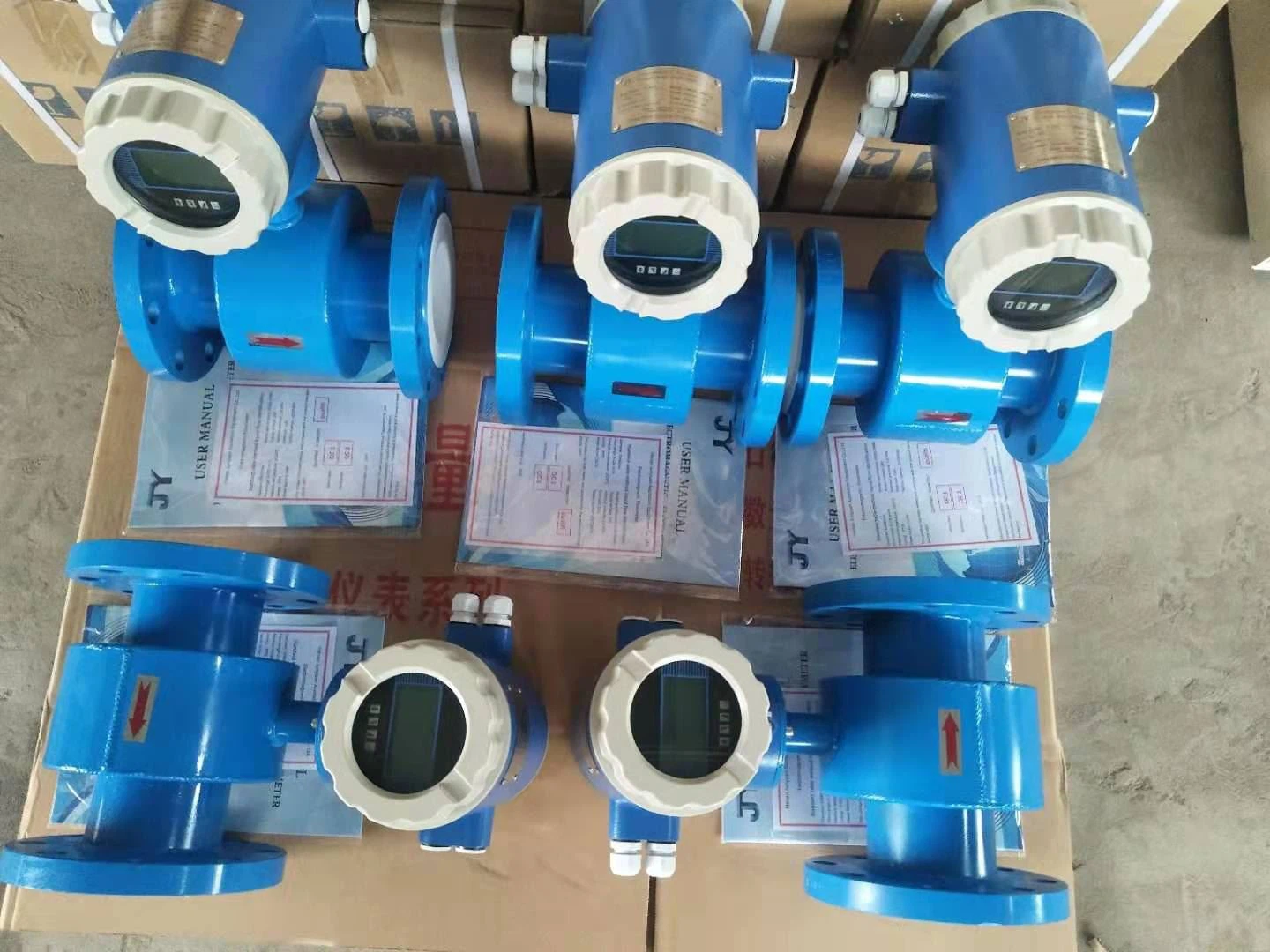
1.The liquid in the electromagnetic flowmeter tube is not full. Due to insufficient back pressure or poor installation position of the flow sensor, the liquid in the measuring tube cannot be filled. The failure phenomenon has different manifestations due to the degree of incompleteness and flow conditions. If a small amount of gas is in a stratified flow or wavy flow in the water pipe, the fault phenomenon is manifested as an increase in error, that is, the flow measurement value does not match the actual value; if the flow is bubble flow or plug flow, the fault phenomenon is except that the measured value does not match the actual value. In addition, output sloshing may occur due to the instantaneous cover of the electrode surface by the gas phase; if the cross-sectional area of the gas in the horizontal pipe stratified flow increases, that is, the degree of liquid underfilling increases, output sloshing will also occur. If the liquid is not full The situation is so serious that if the liquid level is below the electrode, the output will be over-full..
Example 1. A shipyard has a JY series DN80mm electromagnetic flowmeter to measure the water flow. The operator reported that when the flow is zero after closing the valve, the output reaches the full value instead. On-site inspection found that there was only a short pipe downstream of the sensor, and the water was directly discharged into the atmosphere, but the shut-off valve was installed upstream of the sensor. After the valve was closed, the water in the sensor's measuring pipe was completely drained. Refit the valve to the position behind the flowmeter, and the fault will be solved.
2. The liquid contains solids. The liquid contains powders, particles or fibers and other solids, which may cause failures: ① slurry noise; ② electrode surface contamination; ③ conductive deposition layer or insulating deposition layer covering the electrode or lining; ④ lining is worn Or it is covered by sediments, and the circulation cross-sectional area is reduced. If conductive material is deposited on the insulating lining of the measuring tube of the electromagnetic flow sensor, the flow signal will be short-circuited and the meter will fail. Since the conductive material is gradually deposited, this type of fault usually does not appear during the debugging period, but only appears after a period of operation.
Example 2. On the electrolytic cutting process test device in the tool shop of a diesel engine factory, the JY series DN80mm instrument was used to measure and control the flow of saturated salt electrolyte to obtain the best cutting efficiency. At first, the meter was operating normally. After 2 months of intermittent use, the flow rate display value was getting smaller and smaller until the flow rate signal was close to zero. On site inspection, it was found that a layer of yellow rust was deposited on the surface of the insulating layer. After wiping and cleaning, the meter operated normally. The yellow rust layer is caused by the deposition of a large amount of iron oxide in the electrolyte.
This example is a fault during operation. Although it is not a common fault, if the ferrous metal pipeline is severely corroded and the rust layer is deposited, this short-circuit effect will also occur. When it starts to run normally, and the flow display becomes smaller and smaller as time goes by, the possibility of such failures should be analyzed
3. For liquids that may crystallize, the electromagnetic flowmeter should be used with caution. Some chemical materials that are easy to crystallize can be measured normally under normal temperature. Because the fluid conveying pipe has good heat tracing and insulation, it will not crystallize during heat preservation. However, the measuring tube of the electromagnetic flow sensor is difficult to implement heat tracing and insulation. Therefore, when the fluid flows through the measuring tube, it is easy to cause a solid layer on the inner wall due to the temperature drop. Since the use of other principles of flowmeter measurement also has the problem of crystallization, so in the absence of other better methods, a "ring" electromagnetic flow sensor with a very short measuring tube length can be selected, and the upstream pipeline of the flowmeter Heat tracing and insulation are strengthened. Regarding the pipe connection method, the flow sensor is convenient to disassemble and assemble, and it can be easily disassembled for maintenance once it crystallizes.
Example 3 It is not uncommon for electromagnetic flowmeters to fail to work due to liquid crystallization. For example, a smelter installed a batch of electromagnetic flowmeters to measure the flow of the solution. Because the measuring tube of the electromagnetic flow sensor is difficult to heat and keep warm, a layer of crystals formed on the inner wall and the electrode after a few weeks, causing the internal resistance of the signal source to become very high. Large, the meter indicates the value is abnormal. Due to the large diameter of these electromagnetic flowmeters, the frequent disassembly and cleaning were unbearable, so the open channel flowmeter was used in the end.
4. Problems caused by improper selection of the electrode and grounding ring material. The electromagnetic flowmeter and the measured medium are in contact with the parts that are in contact with the electrode and the grounding ring. In addition to corrosion resistance, as long as it is an electrode, the electromagnetic flowmeter is in contact with the medium. Surface effect. Surface effects should include: ①Chemical reaction (formation of a passive film on the surface, etc.); ②Electrochemistry and polarization (generation of electric potential); ③Catalyst effect (generation of aerosol on the surface of the electrode, etc.). The grounding ring also has these effects, but the degree of influence is smaller.
Example 4. A chemical (smelting) factory used more than 20 Hastelloy B electrode electromagnetic flowmeters to measure a hydrochloric acid solution with a higher concentration, and the output signal was unstable. The on-site inspection confirmed that the instrument was normal, and other interference causes that would cause output shaking were also eliminated. However, it works well when measuring hydrochloric acid with Hastelloy B electrode meter in many places. When analyzing whether the cause of the fault is caused by the difference in the concentration of hydrochloric acid, there should be no experience in the effect of the concentration of hydrochloric acid on the electrode surface, and no judgment can be made yet. For this reason, the meter manufacturer and the user unit used the on-site conditions of the chemical plant to do a real flow test to change the concentration of hydrochloric acid. The concentration of hydrochloric acid gradually increases. When the concentration is low, the output of the meter is stable. When the concentration increases to 15%-20%, the output of the meter starts to shake. When the concentration reaches 25%, the amount of output shaking is as high as 20%. After switching to a tantalum electrode electromagnetic flowmeter, it runs normally.
5. Problems caused by the conductivity of the liquid exceeding the allowable range. If the conductivity of the liquid is close to the lower limit, shaking may occur. Because the lower limit specified by the manufacturer's instrument specifications is the lowest value that can be measured under various conditions of use, and the actual conditions cannot be ideal, so I encountered low-grade distilled or deionized water many times. Its conductivity is close to the lower limit 5 specified by the electromagnetic flowmeter specification, but the output shakes when it is used. It is generally believed that the lower limit of conductivity that can be measured stably is 1 to 2 orders of magnitude higher. The conductivity of the liquid can be consulted in the relevant manuals. If there is no ready-made data, it can be sampled and measured with a conductivity meter. But sometimes there are cases where samples are taken from the pipeline to the laboratory to determine that it is available, but the actual electromagnetic flowmeter does not work. This is due to the difference between the liquid when measuring the conductivity and the liquid in the pipeline. For example, the liquid has absorbed CO2 or NO in the atmosphere to generate carbonic acid or nitric acid, and the conductivity increases.
For the noise slurry produced by liquid containing particles or fibers, the method of increasing the excitation frequency can effectively improve the output sloshing. Some frequency-adjustable JYLDE DN300 electromagnetic flowmeters measure the concentration of 3.5% corrugated board slurry, and measure the displayed instantaneous flow sloshing amount at different excitation frequencies on site. When the frequency is lower, 50/32Hz, the shaking is as high as 10.7%; when the frequency is increased to 50/2Hz, the shaking is reduced to 1.9%, and the effect is very obvious.